
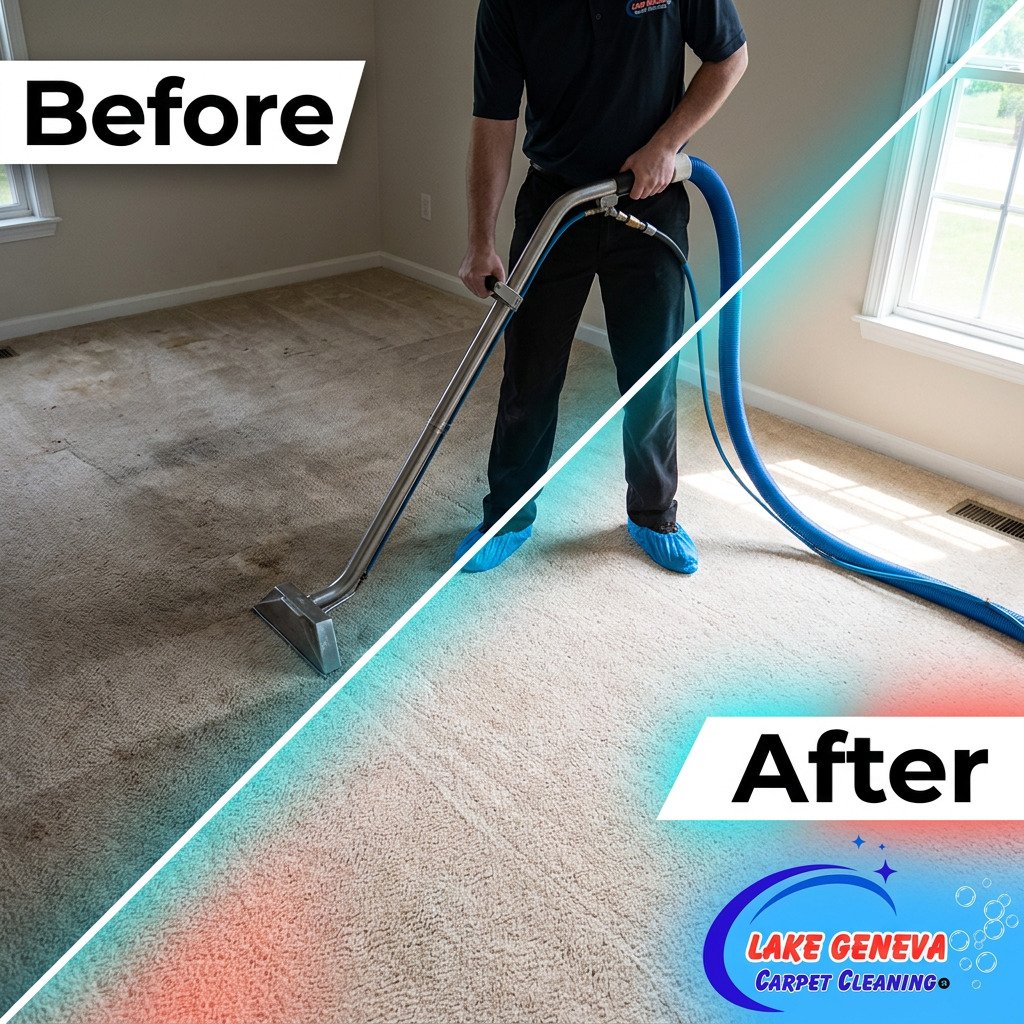
Discover the best way to clean carpets in Lake Geneva. Compare methods, costs, and local pros to find the right solution for your home. Get a free quote.
Table of Contents
- Best Way to Clean Carpets in Lake Geneva: Method Comparison
- Hot Water Extraction (Steam Cleaning)
- Dry Cleaning and Low-Moisture Methods
- Bonnet Cleaning and Encapsulation
- Carpet Cleaning Costs in Lake Geneva: What to Expect
- Average Cost Per Room and Per Square Foot
- Additional Service Fees: Stain Removal, Odor Treatment, and Furniture Moving
- Hidden Costs of Low-Ball Coupons and Bait-and-Switch Pricing
- Professional Carpet Cleaning in Lake Geneva, WI: What Sets Local Pros Apart
- Truck-Mounted Systems vs. Portable Units
- Carpet Material-Specific Pricing: Synthetic vs. Wool Carpets
- Professional vs. DIY: Which Is the Best Way to Clean Carpets in Lake Geneva?
- Best Carpet Cleaning Machines for Home Use in Lake Geneva
- Top Consumer Machines Compared
- How to Remove Carpet Stains: A Room-by-Room Approach
- Pre-Cleaning Preparation Checklist
- How Long Does Carpet Take to Dry After Cleaning in Lake Geneva?
- How to Get an Accurate Service Quote from Lake Geneva Carpet Cleaners
- Conclusion
Last Updated: May 18, 2026
Finding the best way to clean carpets in lake geneva is not as straightforward as most guides suggest. Lake Geneva Carpet Cleaning has spent over 32 years helping Wisconsin homeowners navigate exactly this decision, and the answer almost always depends on three things: your carpet fiber type, the soiling level, and whether you’re doing maintenance cleaning or restorative cleaning. Below, we’ll show you exactly how to match the right method to your situation, what professional cleaning costs in 2026, and where most homeowners waste money on low-ball coupons that deliver disappointing results.
Here’s what most guides get wrong: they treat carpet cleaning as a single category. It isn’t. Hot water extraction, dry cleaning, bonnet cleaning, and encapsulation each perform differently depending on carpet fibers, traffic patterns, and the type of contaminants present. Getting this wrong doesn’t just mean a mediocre result. It can mean shrinkage on wool carpets, residue buildup on synthetic carpet, or a drying time so long that mold becomes a real concern.
Best Way to Clean Carpets in Lake Geneva: Method Comparison
Hot water extraction is widely considered the most effective method for deep cleaning residential carpets, and for good reason. The process forces hot water and cleaning solution deep into carpet fibers, then extracts the water along with dissolved dirt, pet dander, allergens, and bacteria. For Lake Geneva homeowners dealing with Wisconsin’s seasonal mud, road salt, and humidity, this method consistently outperforms alternatives on heavily soiled carpet.
[IMAGE: A professional carpet cleaning technician operating a truck-mounted hot water extraction hose on a residential beige carpet in a bright Lake Geneva living room, with visible steam rising from the carpet fibers and sunlight streaming through large windows | section:Best Way to Clean Carpets in Lake Geneva: Method Comparison]
Hot Water Extraction (Steam Cleaning)
Hot water extraction, often called steam cleaning, is the method recommended by most carpet manufacturers for maintaining warranty validity. A truck-mounted system heats water to high temperatures and injects it into the carpet pile under pressure. The machine then extracts the water, pulling contaminants with it. Drying time typically runs 6 to 12 hours depending on humidity, airflow, and carpet thickness.
Pros:
- Removes embedded allergens, pet dander, and bacteria that surface methods miss
- Recommended by most carpet fiber manufacturers
- Effective for odor treatment and restorative cleaning
- Truck-mounted systems deliver significantly more heat and suction than portable units
Cons:
- Longer drying time than low-moisture methods
- Requires professional equipment for best results
- Can cause issues on wool carpet if water temperature is not carefully managed
:::tip
Open windows and run ceiling fans after hot water extraction. Reducing drying time from 12 hours to 6 hours significantly lowers the risk of mold growth beneath the carpet pad.
:::
Dry Cleaning and Low-Moisture Methods
Dry cleaning methods use chemical compounds or very low moisture to break down soiling, which are then vacuumed away. Drying time is minimal, often under an hour. These methods work well for maintenance cleaning on lightly soiled synthetic carpet or in commercial settings where downtime is a concern.
The limitation is depth. Dry cleaning compounds sit on the surface and do not penetrate deep into carpet fibers the way hot water extraction does. For high-traffic areas, pet odor treatment, or allergen removal, dry cleaning is a maintenance tool, not a restorative one.
Bonnet Cleaning and Encapsulation
Bonnet cleaning uses a rotating pad saturated with cleaning solution to agitate the carpet surface. Encapsulation applies a polymer cleaning solution that crystallizes around dirt particles, which are then vacuumed away. Both methods are popular in commercial settings for their speed.
For residential homeowners in Lake Geneva, encapsulation works well as a between-service maintenance cleaning. It leaves no sticky residue, which is a common complaint with older detergent-based methods. Neither method, however, replaces the deep-cleaning performance of hot water extraction for heavily soiled carpet.
| Method | Drying Time | Best For | Allergen Removal | Cost Level |
|---|---|---|---|---|
| Hot Water Extraction | 6-12 hours | Deep/restorative cleaning | Excellent | Moderate-High |
| Dry Cleaning | Under 1 hour | Maintenance, commercial | Limited | Moderate |
| Encapsulation | 1-2 hours | Maintenance between pro cleans | Moderate | Low-Moderate |
| Bonnet Cleaning | 1-2 hours | Commercial surface refresh | Limited | Low-Moderate |
Carpet Cleaning Costs in Lake Geneva: What to Expect
Carpet cleaning prices in Lake Geneva vary based on square footage, soiling level, carpet fiber type, and whether you need additional services like stain removal or odor treatment. Understanding the pricing structure before you call for a service estimate prevents the most common frustration homeowners report: a quote that doubles by the time the technician finishes.
Average Cost Per Room and Per Square Foot
Professional carpet cleaning in the Lake Geneva, Wisconsin area is priced either per room or per square foot. Per-square-foot pricing is more transparent and easier to verify against the actual scope of work. Per-room pricing tends to favor the customer for smaller rooms and work against them for large, open-plan spaces where a single “room” can exceed 400 square feet.
The table below reflects typical pricing ranges for the Lake Geneva market in 2026. These are not national averages, they reflect the regional cost-of-living context for Walworth County and the surrounding area, where service costs run modestly above rural Wisconsin but below the Chicago metro market that borders the region.
| Service Scope | Typical Price Range | Notes |
|---|---|---|
| Per square foot (truck-mounted HWE) | $0.25 – $0.45/sq ft | Higher end reflects heavily soiled or pet-affected carpet |
| Per square foot (portable unit) | $0.15 – $0.25/sq ft | Lower heat and suction; results vary |
| Single room (up to 200 sq ft) | $75 – $130 | Minimum service charges often apply |
| Single room (200-400 sq ft) | $100 – $175 | Open-plan spaces often priced at the higher end |
| Whole house (3 bedrooms + living areas) | $300 – $550 | Bundled pricing typically reduces per-room cost |
| Whole house (5+ rooms) | $450 – $750+ | Depends heavily on soiling level and fiber type |
| Stairs (per step) | $3 – $6 per step | Labor-intensive; almost always priced separately |
Why whole-house cleaning almost always costs less per room: Most professional services apply a minimum service charge that covers equipment setup, travel, and the first area cleaned. Once the truck is on-site and the hoses are run, the marginal cost of each additional room drops significantly. Booking a single room often costs 60-80% of what two or three rooms cost together. If you’re considering cleaning one room, it is almost always worth adding adjacent areas.
:::tip
Ask for per-square-foot pricing rather than per-room pricing when requesting quotes. It removes ambiguity about room size definitions and makes competing quotes directly comparable.
:::
Pricing by Cleaning Method
The method used directly affects both the price and the result. Not all quotes are for the same service.
| Cleaning Method | Typical Price Range (per sq ft) | Best Application |
|---|---|---|
| Hot water extraction, truck-mounted | $0.40 – $0.80 | Deep/restorative cleaning, allergen removal |
| Hot water extraction, portable | $0.15 – $0.25 | Light maintenance, accessible areas |
| Encapsulation | $0.10 – $0.20 | Between-service maintenance |
| Dry compound cleaning | $0.15 – $0.25 | Commercial, low-downtime settings |
| Bonnet cleaning | $0.10 – $0.18 | Surface refresh, commercial |
A quote for encapsulation or bonnet cleaning that is presented as equivalent to hot water extraction is a red flag. These are maintenance methods, not restorative ones. The price difference reflects a real difference in what the service delivers.
Carpet Material-Specific Pricing: Synthetic vs. Wool vs. Specialty Fibers
This is a pricing factor that most carpet cleaning guides, including most competitors, skip entirely. Carpet fiber type is one of the most significant variables in what you will actually pay, and misunderstanding it leads to either overpaying for unnecessary care or damaging expensive carpet with the wrong method.
Synthetic carpet (nylon, polyester, olefin): The most common fiber type in Lake Geneva homes. Tolerates hot water extraction well, including high water temperatures and standard cleaning solutions. Pricing falls within the standard ranges in the table above. Nylon is the most durable and cleanable synthetic fiber; polyester and olefin are more prone to oil-based soiling that requires specific treatment.
Wool carpet: Requires lower water temperatures, pH-neutral cleaning solutions, and more careful handling to prevent shrinkage, fiber distortion, and color bleeding. Expect a premium of roughly 25 to 40 percent above standard synthetic pricing for professional wool carpet cleaning. A 300-square-foot wool carpet room that would cost $90-$135 in synthetic pricing may run $115-$190. If a service quotes you standard pricing for wool carpet without asking about fiber type, that is a warning sign about their process.
Wool-blend and natural fiber rugs (sisal, jute, seagrass): Natural plant-fiber rugs are particularly sensitive to moisture and should generally not be cleaned with hot water extraction at all. Improper cleaning causes irreversible shrinkage and fiber damage. These require dry or very-low-moisture methods and are typically priced as specialty items, often $3-$8 per square foot depending on the fiber and construction.
Silk and high-end specialty fibers: Silk carpet and rugs require specialist cleaning and are almost always sent to a dedicated rug cleaning facility rather than cleaned in-home. In-home pricing for silk is rarely appropriate, if a service offers to clean silk carpet on-site at standard rates, decline.
:::warning
If you are unsure of your carpet fiber type, tell the service provider before booking. A quick burn test on a few pulled fibers (wool smells like burning hair and produces crushable ash; synthetics melt into a hard bead) can confirm fiber type before any cleaning begins. Getting this wrong on wool or natural fiber carpet can cause permanent damage that no cleaning service will cover.
:::
Additional Service Fees: Stain Removal, Odor Treatment, and Furniture Moving
Base carpet cleaning quotes rarely include everything. These are the add-on fees most commonly omitted from initial quotes, ask about each one before booking:
- Pre-treatment / pre-spotting: Should be included in any professional hot water extraction service. If it is listed as an add-on, ask what the base service actually includes.
- Stain removal (specific treatments): Pet urine, red wine, coffee, and bleach-adjacent stains often carry a per-stain or per-area surcharge. Expect $15-$40 per treated area depending on severity.
- Pet odor treatment (pad-level): Surface odor treatment is different from treatment that penetrates the carpet pad where uric acid crystals accumulate. Pad-level odor treatment requires additional product and time and is typically priced separately, often $30-$75 per affected area.
- Furniture moving: Many services charge $10-$25 per room to move furniture, or require homeowners to clear the room beforehand. Confirm this before the technician arrives.
- Carpet protection application: Post-cleaning protector (such as a fluorochemical protector) adds cost but extends the interval between necessary professional cleanings. Typically $0.10-$0.20 per square foot as an add-on.
- Upholstery cleaning: Often bundled at a discount when combined with carpet cleaning. Ask about combined pricing if you need both.
- Minimum service charge: Most services have a minimum charge of $75-$125 regardless of job size. Factor this in when deciding whether to add rooms to a booking.
:::warning
Always ask for a written service estimate that itemizes every potential add-on before the technician arrives. Verbal quotes that omit furniture moving fees or stain surcharges are the most common source of billing disputes in the carpet cleaning industry.
:::
Hidden Costs of Low-Ball Coupons and Bait-and-Switch Pricing
This is the part most carpet cleaning guides skip entirely. A segment of the industry operates on a bait-and-switch model: advertise an aggressively low flat rate per room, then arrive on-site and upsell aggressively until the final bill bears no resemblance to the original quote.
The red flags are predictable. Quotes below market rate with vague scope. Pressure to add “deodorizer” or “pre-treatment” that should already be included in a proper cleaning. Technicians who describe your carpet as too dirty for the advertised service and require an upgrade to a more expensive method.
A common pattern: a coupon advertises whole-house cleaning for $99. On arrival, the technician explains that your carpet requires “heavy-duty pre-treatment” ($40), that furniture moving is extra ($30), and that the advertised method is only a surface clean, a “deep clean” is available for an additional $120. The $99 job becomes $289 before any work begins.
As documented in the FTC’s consumer guidance on deceptive pricing practices, bait-and-switch pricing is a recognized consumer protection issue. The protection is straightforward: get a written, itemized quote before any work begins and confirm what is and is not included. If a service cannot provide a written itemized estimate before arrival, treat that as a signal.
Owner-operated businesses with long local track records have a reputational stake in transparent pricing that large franchise operations and out-of-area services often lack. The owner’s name is on every job.
How to Get an Accurate Quote: Questions to Ask Before Booking
A quote that does not specify what is and is not included is not a quote, it is a starting point for upselling. Ask these questions before booking any carpet cleaning service in Lake Geneva:
- Is the quote based on room count or square footage? If room count, what is the maximum square footage per room?
- Is pre-treatment or pre-spotting included, or is it an add-on?
- Does the quote include furniture moving, or do rooms need to be cleared in advance?
- Is deodorizer or odor treatment included, or priced separately?
- What is the minimum service charge?
- Is the quote a flat rate or an estimate subject to change based on soiling level?
- What cleaning method is being used, truck-mounted hot water extraction, portable unit, or a low-moisture method?
- What is the satisfaction guarantee policy?
A reputable local service will answer all of these questions directly before you book. Evasive answers to pricing questions are a reliable signal about what the final invoice will look like.
Professional Carpet Cleaning in Lake Geneva, WI: What Sets Local Pros Apart
The gap between a professional clean and a rental-machine DIY job is not subtle. Professional equipment, particularly truck-mounted systems, operates at water temperatures and suction levels that consumer machines cannot match. For Wisconsin homeowners dealing with embedded allergens, seasonal contaminants, and pet odors, that gap translates directly into indoor air quality and carpet longevity.
Truck-Mounted Systems vs. Portable Units
Truck-mounted systems draw power from the vehicle’s engine, which means they generate substantially more heat and suction than any portable unit. Higher water temperature means better cleaning solution activation and more effective allergen removal. Higher suction means faster drying time and less moisture left in the carpet pad.
Portable units, which some professional services use and which are available for consumer rental, operate on standard electrical power. They are adequate for maintenance cleaning and light soiling. For restorative cleaning of heavily soiled carpet, high-traffic areas, or pet-affected rooms, they fall measurably short.
Lake Geneva Carpet Cleaning uses truck-mounted hot water extraction technology specifically because it addresses embedded allergens, pet odors, and seasonal contaminants more effectively than portable alternatives. After 32 years of owner-operated service in Wisconsin, the equipment choice reflects what actually produces results for local homeowners.
Carpet Material-Specific Pricing: Synthetic vs. Wool Carpets
Carpet fiber type directly affects both the cleaning method and the price. Synthetic carpet, including nylon, polyester, and olefin, tolerates hot water extraction well and is the most common fiber type in Lake Geneva homes. Wool carpet requires lower water temperatures, gentler cleaning solutions, and more careful handling to prevent shrinkage and fiber damage.
Expect a premium for wool carpet cleaning, often 20 to 40 percent above synthetic carpet pricing, reflecting the additional care required. Misidentifying your carpet fiber and booking a standard synthetic cleaning package for wool carpet is a mistake that can cause permanent damage.
A quick test: pull a few fibers from an inconspicuous area and burn them. Wool smells like burning hair and produces a crushable ash. Synthetic fibers melt and produce a hard bead. If you’re uncertain, tell the service provider before booking.
Professional vs. DIY: Which Is the Best Way to Clean Carpets in Lake Geneva?
The honest answer is that professional and DIY cleaning serve different purposes. They are not direct substitutes, and treating them as interchangeable is the most common reason homeowners are disappointed with their results, in both directions. Some homeowners overspend on professional cleaning for situations a good consumer machine handles fine. Others delay professional cleaning too long because they assume their rental machine is doing the same job.
Understanding the actual mechanical difference, not just the marketing difference, makes this decision straightforward.
The Equipment Gap: Why Professional Results Are Different, Not Just Better
The performance difference between a truck-mounted professional system and a consumer or rental carpet cleaning machine is not a matter of degree. It is a difference in the underlying physics of the cleaning process.
A truck-mounted hot water extraction system draws power from the vehicle’s engine. This allows it to heat water to temperatures that consumer machines operating on standard 120V household current cannot reach. Higher water temperature does two things: it activates cleaning solutions more effectively, and it kills bacteria, dust mites, and other biological contaminants that survive at lower temperatures.
More importantly, truck-mounted systems generate suction levels that consumer machines cannot match. Suction is what removes moisture from the carpet after cleaning. Higher suction means:
- Less moisture left in the carpet pad, reducing drying time and the risk of mold growth
- More contaminants extracted, dirt, allergens, and cleaning solution residue pulled out rather than redistributed
- Faster drying, typically 6 to 12 hours versus 12 to 24 hours for portable units
Consumer rental machines operate on standard electrical power and are designed to be portable and user-safe, which means they are deliberately limited in both heat output and suction. They are adequate tools for maintenance cleaning and fresh spills. For restorative cleaning of heavily soiled carpet, embedded allergens, or pet odor treatment that has reached the carpet pad, they fall measurably short, not because of operator error, but because of physics.
Cost Comparison: Professional vs. DIY
The cost math is less one-sided than most homeowners assume, particularly for whole-house cleaning.
| Scenario | Professional Cost (est.) | DIY Cost (est.) | Notes |
|---|---|---|---|
| Single room (~200 sq ft) | $75 – $130 | $35 – $55 | Rental machine + solution; time not included |
| 3-room clean | $200 – $350 | $55 – $80 | Rental machines typically charged per day |
| Whole house (5+ rooms) | $350 – $600 | $75 – $120 | DIY cost advantage narrows; time investment grows |
| Pet odor treatment (per room) | $30 – $75 add-on | $15 – $30 (enzymatic cleaner) | DIY enzymatic treatment is genuinely effective for surface odor |
| Allergen removal | Included in HWE | Limited | Consumer machines do not reach temperatures needed for dust mite elimination |
For a single room or spot treatment, DIY rental is often the more cost-effective choice when the soiling is light. For whole-house cleaning, the cost difference between professional service and a full-day rental narrows considerably, and the professional result is measurably better for anything beyond surface maintenance.
Time is the hidden variable in DIY cost calculations. A whole-house DIY clean typically takes 4 to 8 hours including setup, cleaning, and waiting for drying. Professional cleaning of the same space takes 2 to 4 hours with faster drying. For most homeowners, the time cost alone justifies professional service for whole-house cleans.
When to Choose Professional Cleaning
Professional hot water extraction with a truck-mounted system is the right choice when:
- Restorative cleaning is needed, carpet that has not been professionally cleaned in more than 18 months, or that has visible soiling that vacuuming does not address
- Allergen removal is a priority, homes with allergy sufferers, asthma, or young children where dust mite and pet dander reduction matters for indoor air quality
- Pet odor has reached the carpet pad, surface treatment does not address uric acid crystals that have migrated below the carpet fiber into the pad and subfloor
- Wool or specialty fiber carpet, requires controlled water temperature and pH that consumer machines cannot reliably deliver
- Pre-sale or post-tenancy cleaning, where results need to meet a visible standard
- High-traffic areas with embedded soiling, hallways, stairs, and living areas where dirt has been compressed into the fiber base over time
When DIY Cleaning Makes Sense
Consumer carpet cleaning machines, whether purchased or rented, are the right tool when:
- Immediate spot treatment is needed before a stain sets, a consumer machine or portable spot cleaner used within the first hour outperforms a professional service booked for next week
- Maintenance cleaning between professional visits, light soiling in low-traffic bedrooms or guest rooms that do not need restorative cleaning
- Budget constraints require spacing out professional visits, DIY maintenance extends the interval between professional cleans without allowing soiling to compound
- Small, accessible areas, a single area rug, a car interior, or upholstery where a portable machine is the practical tool
How Often Should Lake Geneva Homeowners Clean Their Carpets?
Cleaning frequency recommendations vary by household type. The guidelines below reflect the general consensus from carpet fiber manufacturers and industry organizations, applied to the specific conditions of a Wisconsin home, seasonal mud, road salt tracked in from November through March, and summer humidity that affects drying and mold risk.
| Household Type | Recommended Professional Cleaning Frequency | DIY Maintenance |
|---|---|---|
| Single adult, no pets, low traffic | Every 18 – 24 months | Vacuum weekly; spot treat as needed |
| Couple or small family, no pets | Every 12 – 18 months | Vacuum weekly; DIY clean annually |
| Family with children | Every 6 – 12 months | Vacuum twice weekly; DIY spot treatment as needed |
| Household with 1-2 pets | Every 6 – 12 months | Vacuum twice weekly; enzymatic spot treatment for accidents |
| Household with multiple pets or allergy sufferers | Every 3 – 6 months | Vacuum twice weekly; monthly DIY maintenance |
| Carpet under manufacturer warranty | Per manufacturer specification (typically 12-18 months) | Per manufacturer guidance |
According to the Carpet and Rug Institute’s care and maintenance guidelines, professional hot water extraction is the recommended method for maintaining most residential carpet warranties, and frequency recommendations increase with household traffic and pet presence. Delaying professional cleaning beyond manufacturer-recommended intervals can void warranty coverage on some carpet products, worth confirming with your carpet manufacturer if warranty validity matters.
:::takeaway
The most cost-effective approach for most Lake Geneva homeowners is a combination strategy: professional truck-mounted hot water extraction once or twice per year for restorative cleaning, with consumer machine or spot-treatment maintenance in between. This approach extends carpet life, maintains indoor air quality, and avoids the compounding soiling that makes restorative cleaning more expensive and less effective over time.
:::
The Warranty Factor
Many carpet manufacturers require documented professional cleaning at specified intervals to maintain fiber warranty coverage. This is not a marketing claim, it is a warranty condition written into the product documentation for major carpet brands. Consumer machine cleaning, even with the correct cleaning solutions, typically does not satisfy this requirement because it does not meet the water temperature and extraction standards specified.
If your carpet is under a manufacturer warranty and you are approaching the end of the warranty period, confirm the cleaning documentation requirements before the warranty expires. A professional cleaning receipt from a certified service provider is the documentation most manufacturers require.
Best Carpet Cleaning Machines for Home Use in Lake Geneva
Consumer carpet cleaning machines have improved significantly. For homeowners who want to maintain carpets between professional visits or tackle fresh spills before they set, several solid options exist at different price points.
Top Consumer Machines Compared
Bissell Revolution HydroSteam (starting around $300): The strongest performer for pet owners. HydroSteam technology handles sticky and oily stains that standard hot water alone misses. Multiple cleaning modes and dedicated pet urine treatment make it the most versatile option for households with animals. The trade-off is weight.
Shark CarpetXpert EX151 ($240-$300): Cleans in both directions and delivers strong extraction performance. Lightweight handling makes it practical for whole-house use. The smaller water tank requires more frequent refills, which is a genuine inconvenience for large areas.
Hoover SmartWash+ Automatic Carpet Cleaner ($200-$250): The most user-friendly machine in this category. Triggerless operation eliminates the most common user error (over-wetting the carpet). Strong drying performance reduces the risk of mold. Best choice for homeowners who want reliable results without a learning curve.
Hoover PowerScrub Deluxe ($170-$240): The value pick. Practical full-size features at a lower price point. The shorter hose length limits above-floor cleaning versatility, but for straightforward carpet maintenance, it delivers.
Bissell Little Green Portable Carpet Cleaner ($100-$130): Not a whole-house machine. Exceptional for spot cleaning, upholstery, stairs, and car interiors. Every home with pets or children should own one.
[IMAGE: A homeowner using an upright consumer carpet cleaning machine on a beige carpet in a well-lit home living room, with the machine’s transparent water tank clearly visible showing cleaning solution, afternoon light coming through nearby windows | section:Best Carpet Cleaning Machines for Home Use in Lake Geneva]
| Machine | Price Range | Best For | Tank Size | Drying Performance |
|---|---|---|---|---|
| Bissell Revolution HydroSteam | $300+ | Pet owners, oily stains | Large | Good |
| Shark CarpetXpert EX151 | $240-$300 | Whole-house, lightweight use | Small | Good |
| Hoover SmartWash+ | $200-$250 | User-friendly whole-house | Medium | Excellent |
| Hoover PowerScrub Deluxe | $170-$240 | Budget maintenance | Medium | Moderate |
| Bissell Little Green | $100-$130 | Spot cleaning, upholstery | 48 oz | N/A |
How to Remove Carpet Stains: A Room-by-Room Approach
Stain removal success depends almost entirely on response time. A stain treated within the first few minutes is a fundamentally different problem than one that has dried and bonded to carpet fibers. The cleaning solution matters, but speed matters more.
Kitchen: Food and grease stains respond well to a dish soap and water solution applied immediately. Blot, never scrub. Scrubbing spreads the stain and pushes it deeper into carpet fibers.
Living room: Red wine and coffee should be blotted immediately with cold water. Avoid hot water on fresh stains, which can set proteins. Club soda works on fresh wine spills.
Bedroom: Ink stains respond to isopropyl alcohol applied with a clean cloth. Work from the outside edge toward the center to prevent spreading.
Pet areas: Pet urine requires an enzymatic cleaner to break down the uric acid crystals that cause odor. Standard detergents mask the smell temporarily but do not eliminate the odor source. Enzymatic cleaners are available at most Lake Geneva hardware and pet supply stores.
Pre-Cleaning Preparation Checklist
Preparing properly before a professional cleaning visit or a DIY session makes a measurable difference in results.
- [ ] Vacuum the entire area thoroughly before any wet cleaning begins. Wet cleaning on a heavily vacuumed carpet performs significantly better.
- [ ] Move small furniture items and breakables out of the cleaning area
- [ ] Pre-treat visible stains with appropriate spot treatment 10-15 minutes before cleaning
- [ ] Identify any wool or natural fiber rugs that require special handling
- [ ] Clear pathways for equipment access, particularly for truck-mounted hose routing
- [ ] Plan for drying time: arrange alternative foot traffic routes for 6-12 hours post-cleaning
- [ ] Communicate pet urine locations to the technician before cleaning begins, even if not visually obvious
:::takeaway
Pre-vacuuming before professional carpet cleaning is the single most overlooked preparation step. It removes dry soil that wet cleaning then has to work around, allowing the hot water extraction to focus on embedded contaminants rather than surface debris.
:::
How Long Does Carpet Take to Dry After Cleaning in Lake Geneva?
Carpet drying time after cleaning depends on the cleaning method, equipment quality, carpet thickness, humidity, and airflow. Hot water extraction with a truck-mounted system typically results in drying times of 6 to 12 hours under normal conditions. Portable units leave more moisture in the carpet, extending drying time to 12 to 24 hours.
Lake Geneva’s climate is a relevant factor. Summer humidity slows drying considerably. Winter cleaning, paradoxically, often dries faster because indoor heating systems actively dehumidify the air. Running ceiling fans, opening windows when weather permits, and avoiding foot traffic on wet carpet all reduce drying time.
Walking on wet carpet compresses the fibers and can cause matting or re-soiling from shoe traffic before the carpet is fully dry. Booties or clean socks are the minimum; bare feet transfer oils to wet fibers.
If carpet is still damp after 24 hours, particularly in a basement or poorly ventilated room, run a dehumidifier. Prolonged moisture beneath the carpet pad creates conditions for mold and mildew growth, which is a health concern and a significantly more expensive remediation problem.
How to Get an Accurate Service Quote from Lake Geneva Carpet Cleaners
Getting a meaningful service estimate requires asking the right questions. A quote that doesn’t specify what is and is not included is not a quote. It’s a starting point for upselling.
Questions to ask before booking any carpet cleaning service in Lake Geneva:
- Is the quote based on room count or square footage? If room count, what is the maximum square footage per room?
- Is pre-treatment or pre-spotting included, or is it an add-on?
- Does the quote include furniture moving, or do rooms need to be cleared in advance?
- Is deodorizer or odor treatment included, or priced separately?
- What is the minimum service charge?
- Is the quote a flat rate or an estimate subject to change based on soiling level?
- What is the satisfaction guarantee policy?
A reputable local service will answer all of these questions directly before you book. Evasive answers to pricing questions are a reliable signal about what the final invoice will look like.
For homeowners near Lake Geneva who want transparent pricing without surprises, booking with an owner-operated business that has a long local reputation is the most reliable path to an accurate quote. The owner’s name is on the work.
Keeping carpets clean in a Wisconsin home is a year-round challenge: road salt in winter, mud in spring, humidity in summer, and leaf debris in fall all work against you. Lake Geneva Carpet Cleaning has served homeowners across the Lake Geneva area for over 32 years using truck-mounted hot water extraction technology and eco-friendly cleaning solutions, with a 10-day satisfaction guarantee that removes the risk from every booking. Get started with Lake Geneva Carpet Cleaning and experience the difference between surface-level results and a genuinely deep clean that improves your home’s indoor air quality.
Frequently Asked Questions
How often should I have my carpets professionally cleaned in Lake Geneva?
Most homeowners in Lake Geneva benefit from professional carpet cleaning at least once a year. However, households with pets, children, or high-traffic areas may need deep cleaning every six months. Seasonal contaminants like road salt and mud tracked in during Wisconsin winters can accelerate soiling, making a spring restorative cleaning especially valuable. Regular maintenance cleaning between professional visits helps extend carpet life and maintain indoor air quality year-round.
Is steam cleaning better than dry cleaning for carpets?
For most Lake Geneva homeowners, hot water extraction, commonly called steam cleaning, delivers a deeper clean by flushing embedded dirt, pet dander, and allergens from carpet fibers. Dry cleaning uses less moisture and offers faster drying time, making it suitable for maintenance cleaning or delicate wool carpet. However, for restorative cleaning in high-traffic areas or after pet accidents, truck-mounted hot water extraction is generally the superior method due to its superior extraction power and allergen removal capability.
Are there eco-friendly carpet cleaning services in Lake Geneva, WI?
Yes. Several professional carpet cleaning providers in Lake Geneva, including Lake Geneva Carpet Cleaning, use eco-friendly and pet-safe cleaning solutions as part of their standard service. These cleaning solutions are designed to effectively remove dirt, germs, and odors without harsh chemicals, making them a safe choice for homes with children, pets, or allergy sufferers. When requesting a service quote, ask specifically about the cleaning solution used to confirm it meets your household’s needs.
How long does carpet take to dry after professional cleaning in Lake Geneva?
Drying time after professional carpet cleaning typically ranges from two to six hours, depending on the method used, humidity levels, and airflow in your home. Hot water extraction with a truck-mounted system generally leaves carpets drier than portable units due to stronger suction. In Wisconsin’s humid summer months, drying time may be longer. Opening windows, running ceiling fans, or using a dehumidifier can significantly speed up the process and reduce the risk of mildew forming in carpet fibers.
How do I remove tough stains from carpets before a professional arrives?
Act quickly, blot the stain with a clean white cloth rather than rubbing, which can spread it deeper into carpet fibers. For pet urine, apply cold water and blot repeatedly. Avoid using hot water, which can set protein-based stains. A mild dish soap diluted in water works for many common stains. For stubborn or set-in stains, avoid over-saturating the carpet, as excess moisture can cause odor issues. A professional stain removal service will have specialized cleaning solutions for stains that resist DIY treatment.
Frequently Asked Questions
undefined
Most homeowners in Lake Geneva benefit from professional carpet cleaning at least once a year. However, households with pets, children, or high-traffic areas may need deep cleaning every six months. Seasonal contaminants like road salt and mud tracked in during Wisconsin winters can accelerate soiling, making a spring restorative cleaning especially valuable. Regular maintenance cleaning between professional visits helps extend carpet life and maintain indoor air quality year-round.
undefined
For most Lake Geneva homeowners, hot water extraction — commonly called steam cleaning — delivers a deeper clean by flushing embedded dirt, pet dander, and allergens from carpet fibers. Dry cleaning uses less moisture and offers faster drying time, making it suitable for maintenance cleaning or delicate wool carpet. However, for restorative cleaning in high-traffic areas or after pet accidents, truck-mounted hot water extraction is generally the superior method due to its superior extraction power and allergen removal capability.
undefined
Yes. Several professional carpet cleaning providers in Lake Geneva, including Lake Geneva Carpet Cleaning, use eco-friendly and pet-safe cleaning solutions as part of their standard service. These cleaning solutions are designed to effectively remove dirt, germs, and odors without harsh chemicals, making them a safe choice for homes with children, pets, or allergy sufferers. When requesting a service quote, ask specifically about the cleaning solution used to confirm it meets your household’s needs.
undefined
Drying time after professional carpet cleaning typically ranges from two to six hours, depending on the method used, humidity levels, and airflow in your home. Hot water extraction with a truck-mounted system generally leaves carpets drier than portable units due to stronger suction. In Wisconsin’s humid summer months, drying time may be longer. Opening windows, running ceiling fans, or using a dehumidifier can significantly speed up the process and reduce the risk of mildew forming in carpet fibers.
undefined
Act quickly — blot the stain with a clean white cloth rather than rubbing, which can spread it deeper into carpet fibers. For pet urine, apply cold water and blot repeatedly. Avoid using hot water, which can set protein-based stains. A mild dish soap diluted in water works for many common stains. For stubborn or set-in stains, avoid over-saturating the carpet, as excess moisture can cause odor issues. A professional stain removal service will have specialized cleaning solutions for stains that resist DIY treatment.